Showing posts with label Appears in At the Water's Edge. Show all posts

Sunday, September 28, 2008

Sabbath


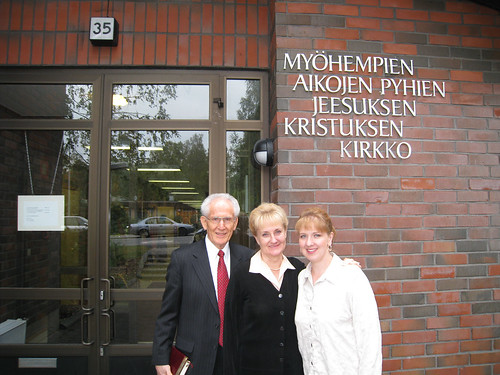
Mom and Dad know me so well. Even though the temple is in a different ward's boundaries, they knew that come Sunday, I'd love to visit what was my home ward during those three years.

Observations:
  • The brick paving the parking lot looks paler than I remember it. Either it's faded from a pretty pinkish to nearly gray-white, or I'm not remembering it correctly.
  • For rain downspouts, there used to be huge chains coming down from the roof that were then attached to concrete blocks on the ground. As weird as they were, it was a bit sad to see that the chains are gone and the chapel now has actual downspouts.
  • The interior looks the same as it always did, although some rooms are now being used for different things. The Young Women room and bishop's office have swapped locations, for starters.
  • I could practically see little ghosts of me, my sisters, many of the missionaries we knew, and several events (a wedding, a Halloween party put on for the English class kids, chatting with elders in the hall, a baptism . . .).
  • While we lived there, Bishop Eklund presided over the ward. Today it's Bishop Eklund . . . the son. Who was in Young Mens when I was a Beehive. How trippy is THAT?

Dad used to tell us girls that if we didn't speak Finnish at home, that eventually we'd forget it. I used to think, Right. I'll forget how to breathe, too. Lo and behold, several years later, it did start to fade away.

Sitting in sacrament meeting, I suddenly remembered why I fought the idea of speaking Finnish at home, at least during the mission. I could understand most of what was said by the speakers when I concentrated really hard. But if I let my mind wander for even a second, I'd lose it. And by the end of the meeting, my brain was nearly fried.

Back in the 80s, after spending a full day at school concentrating . . . HARD . . . on the language, my brain was little better than cottage cheese. I'd forgotten what that felt like. During the mission, when I came home, I just had to rest my brain. But dang, I do wish we'd spoken Finnish when we returned to Utah.

After church, Dad took me and Rob inside the temple to look around. The reverence Dad has for the temple is palpable. The temple itself is easily the most gorgeous one I've ever seen the interior of. And the entire place is infused with the Spirit in a way that I'd never felt before, even inside other temples.

On our way out, I teared up. I didn't want to walk back out. I could have stayed there for hours, just soaking up the feel and the beauty. But alas, all things must come to an end, and I knew I'd be back in a few days for an actual session.

The Laukkanens, some old family friends, came for dinner. We played some table games and chatted, and then we called it a night.

All in all, a great sabbath.

Seurasaari

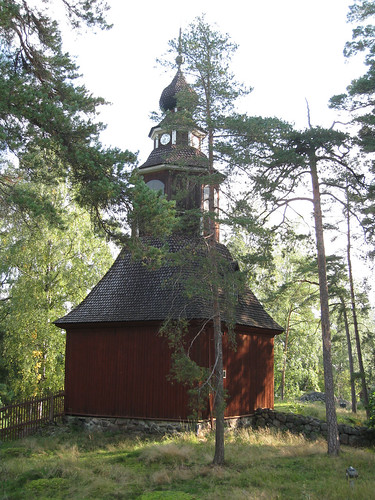
Yet another location from my book. (You can tell many of the things that impacted me as a kid, because they show up in it.) Here's me with Dad on the bridge leading into Seurasaari, which is an outdoor museum. It has lots of historic buildings and other structures brought from all over the country.

We brought bread and trail mix to feed the animals. The ducks and even some swans gathered around real quick when they saw us throwing bread into the water.
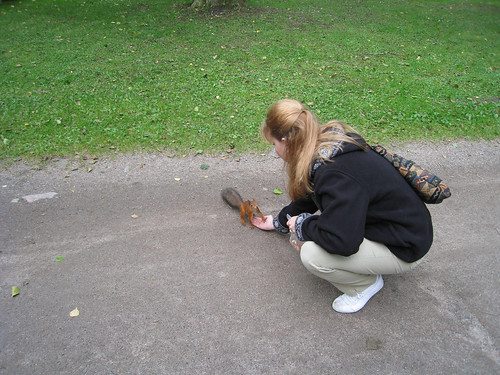
Not far into the park, we had birds following us. On a lark (no pun intended) Rob decided to try feeding them to see if they'd come. Several birds came and ate right out of his hand!

We had several squirrels following us as well, especially this little guy. He ate plenty that we dropped in front of him, but he seemed so comfortable around people I thought he just might eat from my hand. Waddaya know!

Dad and me strolling along the paths.
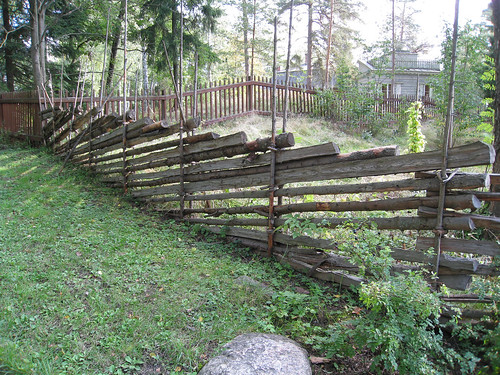


A neat fence: simple to construct, yet effective. Once we noticed them at Seurasaari, we noticed them in other historic locations we went to.


A tree that is protected and is considered a landmark of sorts because it's got a giant ant hill inside.


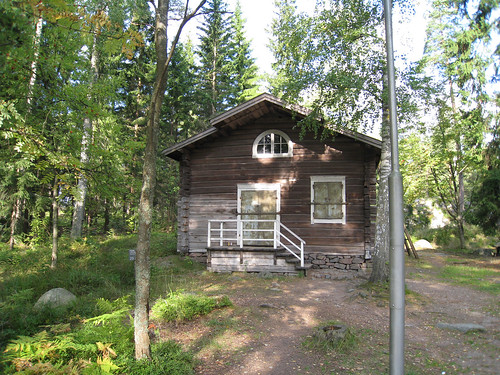
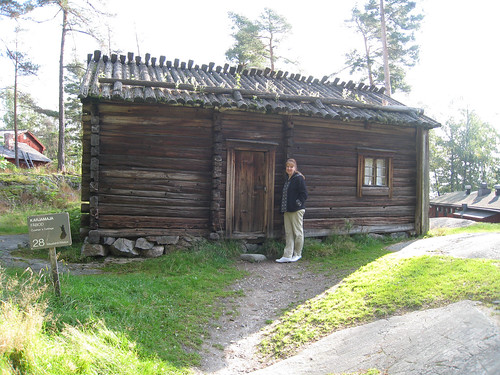
Hanging out by an old cabin.

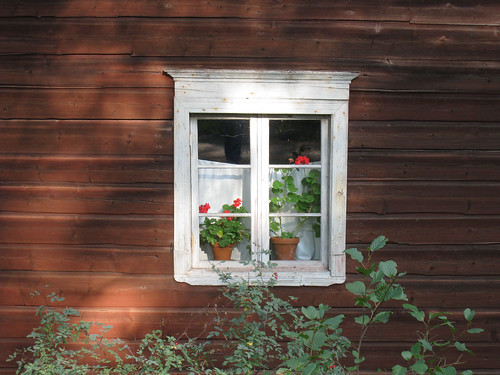
I decided to use this picture as my computer wallpaper for a while. It's so pretty, and it's very Finnish. You can't go anywhere without seeing colorful flowers in windows, and seeing them inside a historic building has just that much more flavor.


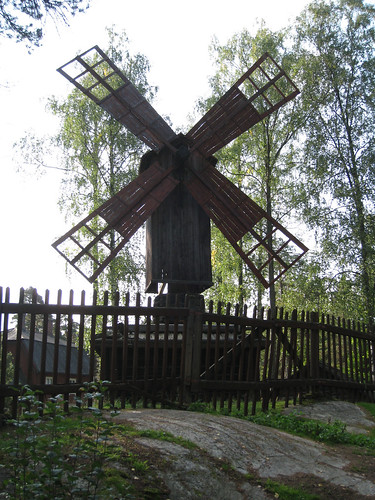
A windmill.


A close-up of the windmill's construction. I can't even imagine how long it would take (not to mention the craftsmanship involved) in making this kind of thing.
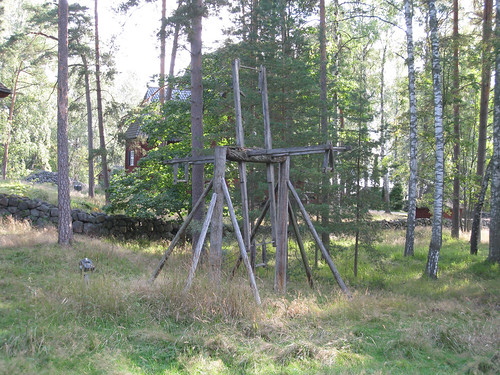
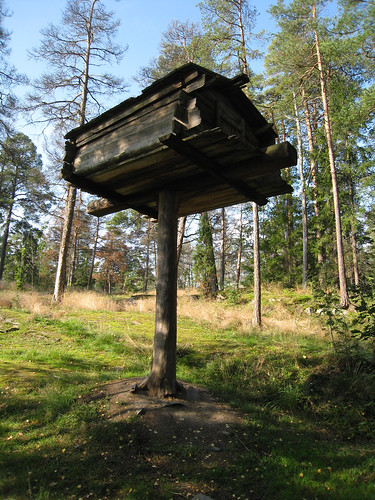

An old wooden swing.

What food storage looked like for northern Finns long ago: high enough so bears and other animals couldn't get to it.

Weird natural phenomenon here: a perfectly round cut-out filled with water. As you can see, it even has its own sign announcing its bizarre presence. A close-up is below.


Friday, September 26, 2008

Suomenlinna Fortress


Suomenlinna (Finland's Fortress) was near the top of my list of "must see again" locations. It's an island fortress built in the early 1800s, a 15-minute ferry ride off the coast of Helsinki. It was built by a Swedish king as a defense against Russia but has been used for other military purposes since. Some retired military families also live inside the fortress, in refurbished apartments. During the winter, a van service brings people back and forth instead of the ferry.


We got a kick out of this sign. You probably can't read it, but under "Regulations," it describes things that are not allowed on the island (among them: littering, entering private homes, drinking alcohol, and such).

The last item on the list? Probably not something you see on many signs:

No cycling on the ramparts.


I love this place, which is one reason it plays a role in ATWE.


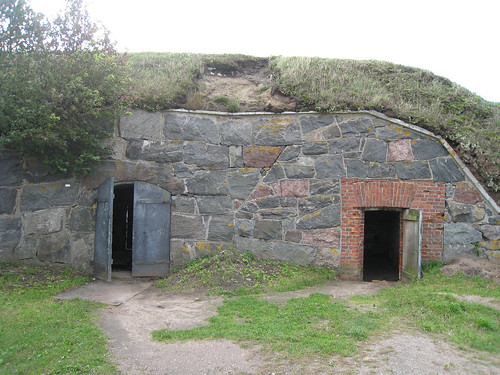
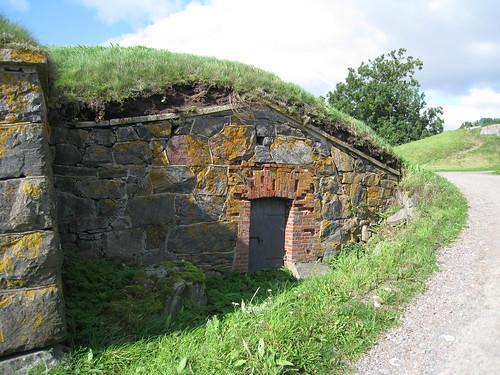
Looks almost like a Hobbit hole . . .


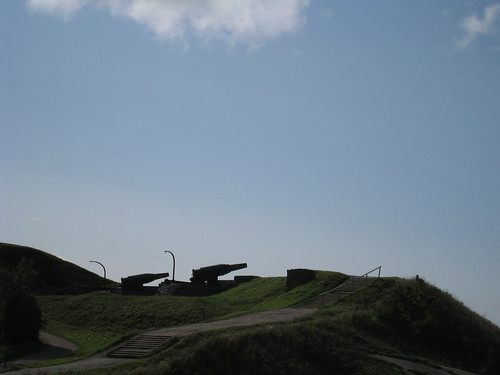
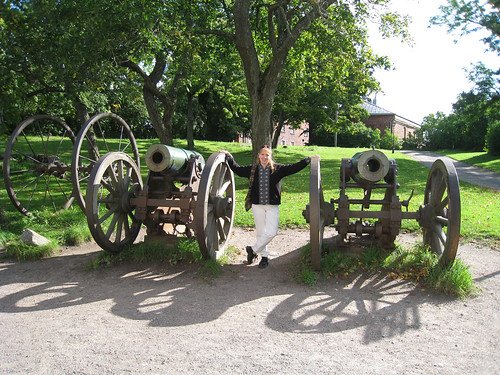
Cannons pointing out toward the water.


Storage areas. Near the cannons, so I'm guessing they're magazines.


View of Helsinki from the island. The tall green spire on the left is the National Museum.


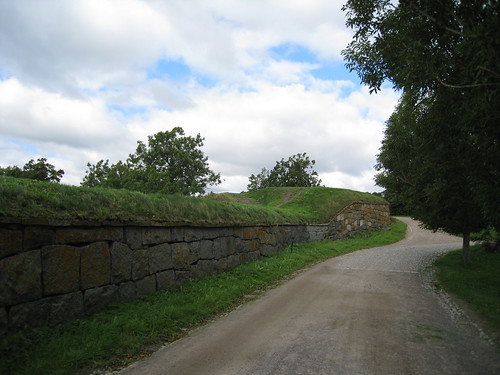
Another view where you almost expect Hobbits to show up.


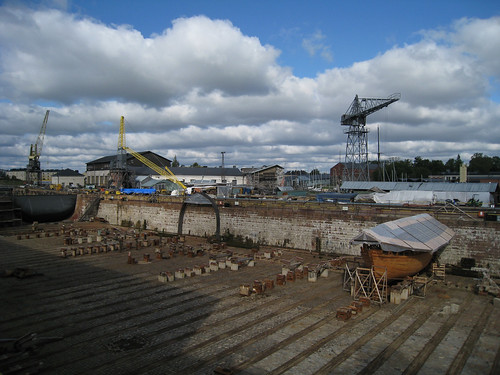
The dry dock. One end opens to the ocean and fills with water. Then ships come in and the water is drained out so the vessels can be worked on. It's very old, but it's still in use today.


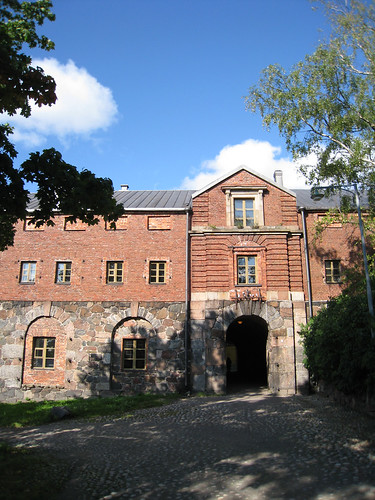
One of the old buildings. Looked like it was a storage area for food and/or animals.


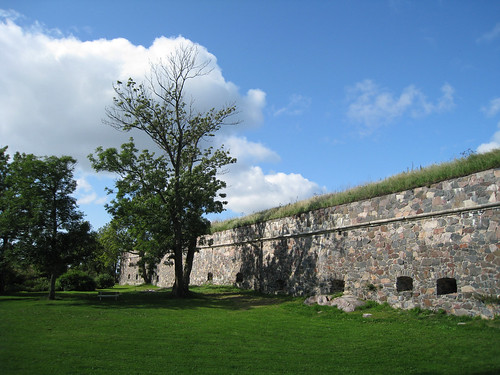
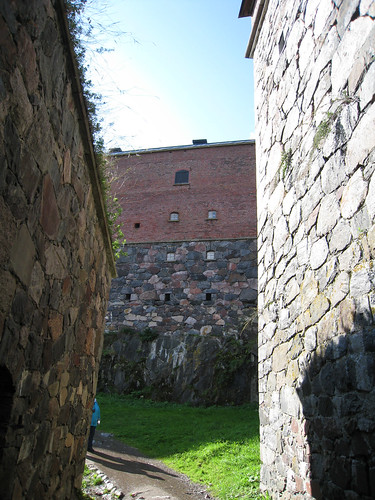
Here's a long fortress area where soldiers would fight from. There are tons of little alcoves along the passage where they'd gather.


One of the alcoves. The slits in the wall are where they'd stick out their rifles to shoot from.


Neat to see the different layers of building. You can tell what's older and what was added later based in part on the building material used (stone versus brick).


The Suomenlinna church. Note the "fence," which is made out of chains and old cannons.


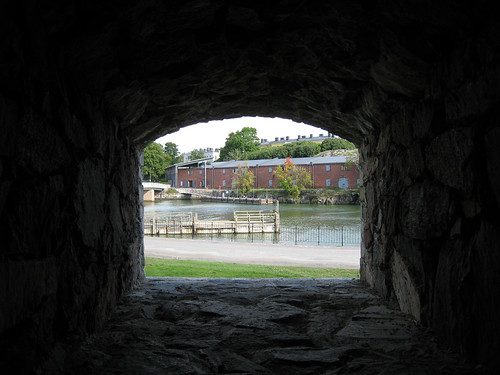
Walking through one of many tunnels. It was interesting to see "library" and other signs along the way. This is really a community embedded inside a national monument.


It was quite cold and windy the day we visited. We had a while to wait for the return ferry, so we dropped in on the island's little grocery store. We got some drinks and snacks. I picked a bottle of Pommac, a soda I'd all but forgotten about.

With my first sip, a flood of sensations and familiarity once again came over me. Good stuff, that Pommac!

Sight for Sore Eyes


During the three years my family lived in Finland, I attended the public school. It was difficult, but somehow I made friends even though we didn't share a common language, at least for the first year until I learned enough Finnish to get by.

Katri (left) was the first person to invite me to her place to play. We walked to her apartment (featured prominently in ATWE as Sister Henderson's) and did our best to communicate by passing a dictionary back and forth.

We soon learned that chess is an international language, so we played a lot of that. I also borrowed books from her mother's collection of Agatha Christie novels (in English! The sweetness!).

Katri and I have kept in touch over the years (now in English, alas . . . my near-fluent Finnish from '87 is now sadly lacking), and I absolutely had to see her when we visited.

To my delight, she arranged for another dear classmate, Leena (right), to join us. I'd been out of touch with Leena for years but had wonderful memories of times together.

After we came home, I dug up one of class picture from '85. By a twist of fate, all three of us are standing beside one another in the same order as in the picture above:


Seeing them both again was wonderful and a definite high-point for me. Leena brought along her son Mikko, who was about 8 months old. She also has a three-year-old, and it was fun to talk about mommy things like potty training and sleepless nights—topics we most certainly didn't have to talk about when we were eleven or twelve.

Katri treated us (me, her boyfriend Antti, and Leena) to a sightseeing cruise around Helsinki. It was absolutely beautiful, in spite of the wind, and we had a great time catching up.

Afterward, Katri and Antti took me out to dinner, and we finished off the evening with desserts from the Fazer cafe. (Holy YUM!!!)

Rob went back to the apartment to sleep off some jet leg, so he wasn't there for this part. This means that it didn't even occur to me to take my camera out of my purse during the cruise or dinner. Brilliant. Fortunately, Rob was there at the initial reunion, so we have at least one picture.

The National Museum

When I think of the Finnish National Museum, this is what I think of first: the frescoes on the ceiling when you first walk in, reflecting scenes from The Kalevala. (Like many aspects of Finland, I used them in ATWE.)


Above: The center scene is the hero Väinämöinen fighting off an attack from the Mistress of the North that results in the sampo being broken and falling into the sea.

To the right you can make out a bit of the forging of the sampo, a mill that provided all the things that made life good: salt, wheat, and gold. When it broke and fell into the sea, it continued to produce salt, which is why the ocean is salty. Parts of it washed up on the southern end of Finland, which is why it's supposed to be the best and most prosperous area.


Above: Center image is Ilmarinen doing one of many feats to win the Maid of the North: plowing a field of snakes.

To the left is the creation of the kantele, an Finnish instrument. In the stories (and in the painting), Väinämöinen's men caught a massive pike and used the jawbone to make the kantele.


The entire building is beautiful, from the turret and bear statue outside to the stained-glass windows.


A reconstructed cabin with how people lived long ago in the area.


A model of traditional Finnish clothing/costumes. No idea why I have that weird look on my face.

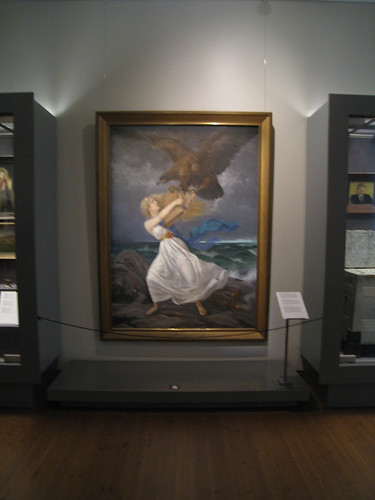
Probably one of the most famous Finnish paintings, this represents the maid of Finland and the two-headed eagle of Russia trying to rip the law from her hands. To say that Russia and Finland have a rocky history would be an understatement.


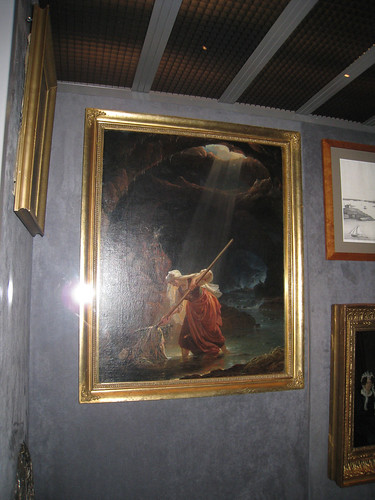
Another painting from The Kalevala, only one we'd never seen before. It's where Ilmarinen has been killed and his body torn apart, and his mother goes to the river of the underworld to rake up the pieces. A bee comes that brings him back to life. It's an eerie picture (although you can't really see all his body parts floating around in the photo). So well done.

Rooms and rooms were filled with fancy artifacts from the past, many from the era where Finland was a grand duchy of Russia. Note the tsar's throne to the left.

Very old and beautiful wooden chests below and cabinets above. With the dark, long winters here, it's no wonder, really, that the people use bright colors to liven things up. They were intricate and amazing to look at.

Some fun grandfather clocks (and one grandmother clock—note the arms and shape of the one second to last), again with bright colors.
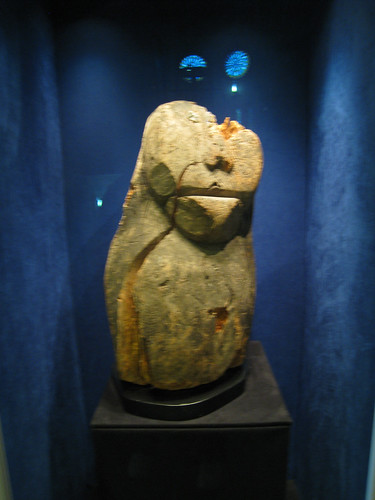
A rather obscure bit we found: an idol fishermen used in hopes of a good catch after their church burned down. Apparently when it didn't work, a monk threw it into the ocean. But when it washed up elsewhere, the people there caught lots of fish and kept it as good luck.


Now that's a fun book shelf!